In order to develop the Clinical Trial Risk Tool, we had to conduct a quality control exercise on the components. Each parameter which is fed into the complexity model is trained and evaluated independently. For an overview of how the tool works, please read this blog post.
I used two datasets to train and evaluate the tool:
By combining the two datasets I was able to get some of the advantages of a large dataset and some of the advantages of a smaller, more accurate dataset.
For validation on the manual dataset, I used cross-validation. For validation on the ClinicalTrials.gov dataset, I took the third digit of the trial’s NCT ID. Trials with values 0-7 were used for training, with value 8 were used for validation, and those with value 9 are held out as a future test set.
Validation scores on small manually labelled dataset (about 100 protocols labelled, but 300 labelled for number of subjects). You can reproduce my experiments using the notebooks from this folder.
| Component | Accuracy – manual validation dataset | AUC – manual validation dataset | Technique |
| Condition (Naive Bayes: HIV vs TB) | 88% | 100% | Naive Bayes |
| SAP (Naive Bayes) | 85% | 87% | Naive Bayes |
| Effect Estimate | 73% | 95% | Naive Bayes |
| Number of Subjects | 69% (71% within 10% margin) | N/A | Rule based combined with Random Forest |
| Simulation | 94% | 98% | Naive Bayes |
You can reproduce my experiments using the notebooks from this folder. As a sanity check I also trained a Naive Bayes classifier for some of these components to check that our models are outperforming a reasonable baseline.
| Component | Accuracy – ClinicalTrials.gov validation dataset | Baseline Accuracy (Naive Bayes) – ClinicalTrials.gov validation dataset | Technique |
| Phase | 75% | 45% | Ensemble – rule based + random forest |
| SAP | 82% | Naive Bayes | |
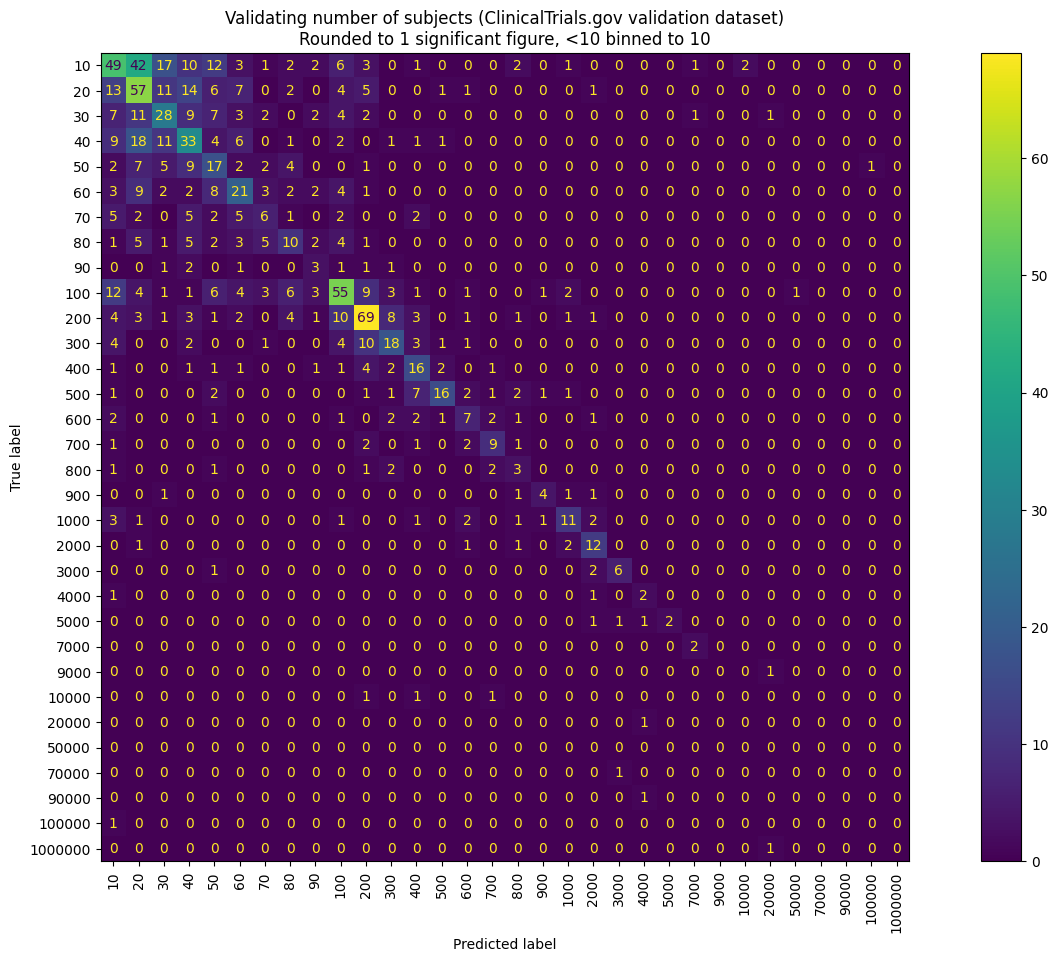
| Number of Subjects | 13% | 6% | Rule based combined with Random Forest |
| Number of Arms | 58% | 52% | Ensemble |
| Countries of Investigation | AUC 87% | N/A | Ensemble – rule based + random forest + Naive Bayes |
In particular I found that the ClinicalTrials.gov value for the sample size was particularly inaccurate, hence the very low performance of the model on that value.
By far the most difficult model was the number of subjects (sample size) classifier.
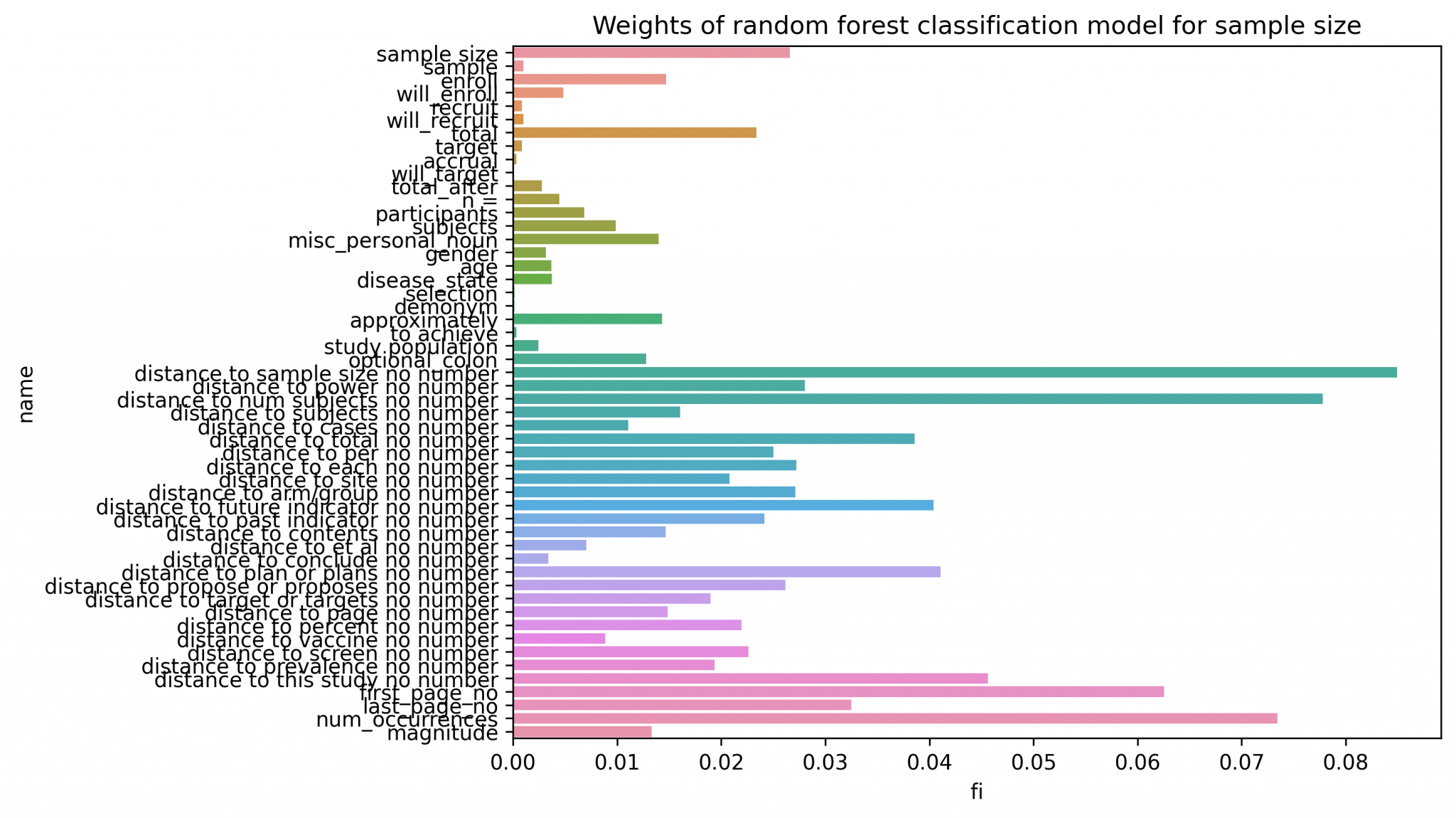
I designed this component as a stage of manually defined features to identify candidate sample sizes (numeric values in the text), combined with a random forest using these features to identify the most likely candidate. Here is an output of the feature importances of the random forest model.
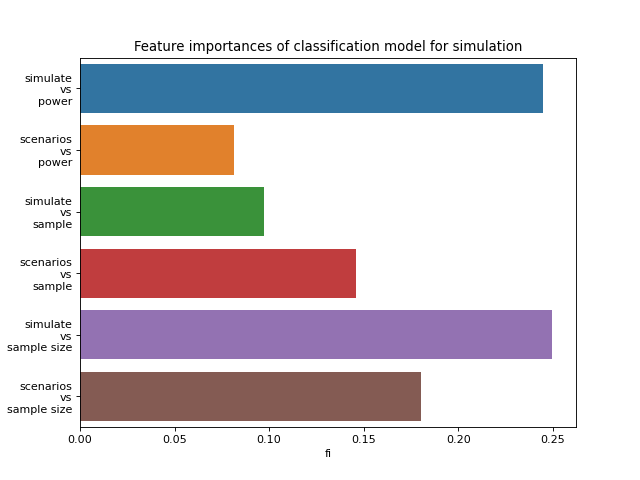
Similarly, the simulation classifier is a random forest that uses manually defined features of key words:
For any of the components, we also plotted a Confusion Matrix.
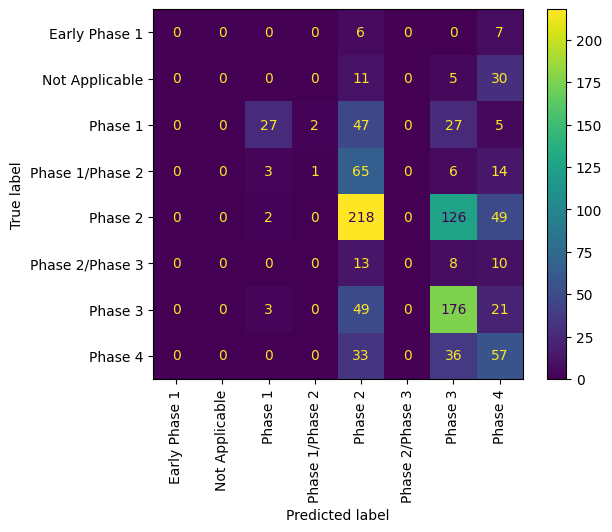
Confusion matrix for the baseline (Naive Bayes) phase extractor on the ClinicalTrials.gov validation dataset
Since each component is designed differently, it has been complex to validate the performance for clinical trial risk assessment.
However I have provided some Jupyter notebooks in the repository to run the validation and reproduce my results.
There is still much scope for improvement of several features, especially sample size.
Some parameters, such as simulation, were not available in the ClinicalTrials.gov dataset and so could only be trained and validated manually. We hope to be able to annotate more data for these areas.
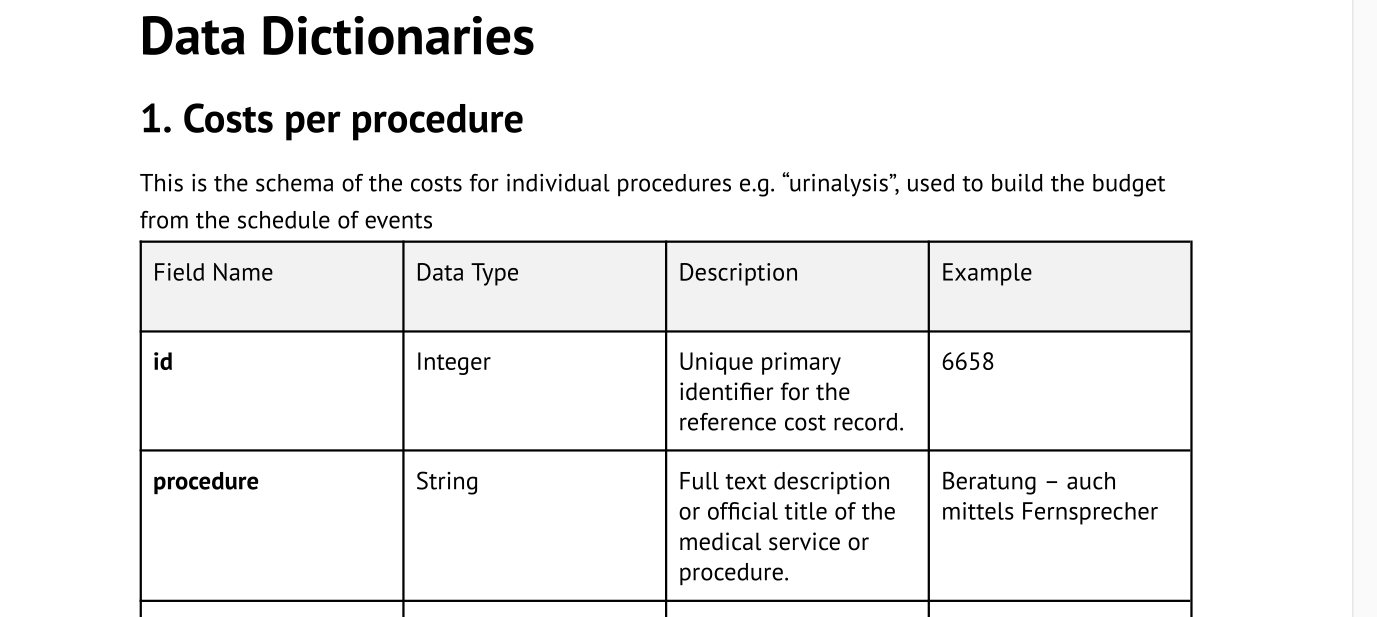
The Clinical Trial Risk Tool estimates top down cost and itemised site budgets using proprietary cost datasets of trial costs and procedure costs. These costs are assembled from publically available data. You can click below to view our data dictionary. Clinical Trial Risk Tool Trial cost data You can download the data dictionary used for cost estimation in the Clinical Trial Risk Tool Download data dictionary
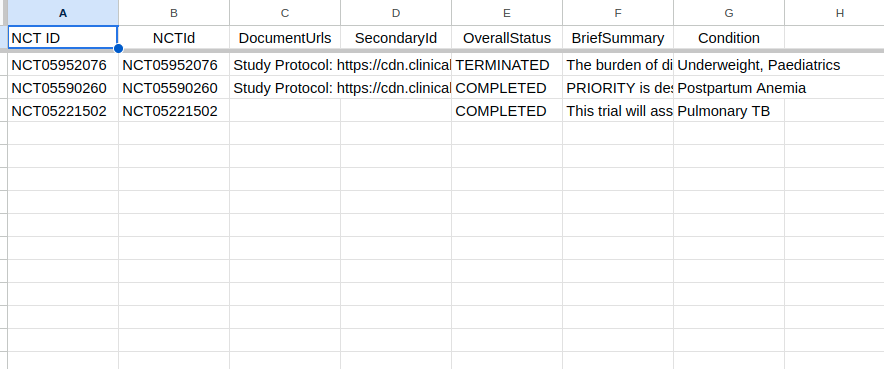
Clinical Trial Data Lookup Google Sheets™ plugin Do you need to look up clinical trial data from the NCT ID? Fast Data Science has developed a Google Sheets™ add-on (plugin) which finds clinical trials data. The plugin uses the clinicaltrials.gov API. Clinical Trial Data Google Sheets™ Plugin Install plugin Install the free Google Sheets™ plugin for looking up clinical trial data Install Plugin The user will provide a number of NCT IDs in column A (or whichever one they choose) in the Google Sheet™, and the tool will look up those NCT IDs and retrieve information on those trials and populate that information into columns.

You may have been tasked with creating a clinical trial site budget. This is a budget itemising all the costs that will be incurred at the study site. The site budget may be needed To estimate the total cost of that site running part of the trial, as part of a bid to the CRO or sponsor To identify who needs to be reimbursed for each cost item To ascertain whether or not it is feasible to run the trial at that site To ensure that the site is reimbursed for the costs that they incur while running the trial If you are building a site budget, the most important document is the study protocol.