
You may have been tasked with creating a clinical trial site budget. This is a budget itemising all the costs that will be incurred at the study site.
The site budget may be needed
If you are building a site budget, the most important document is the study protocol. The protocol has a list of all procedures that the study subjects will undergo, called the Schedule of Events. Sometimes, you will not have access to the study protocol - just a trial synopsis - but in any case you need the Schedule of Events. This is the bare minimum to create a site budget.
In addition to the protocol, ideally you should have most of the following, but you can make a rough site budget without them.
The study protocol contains the schedule of events. If you find the schedule of events, you will see “procedure” in the rows and “visit number” in the column headers.
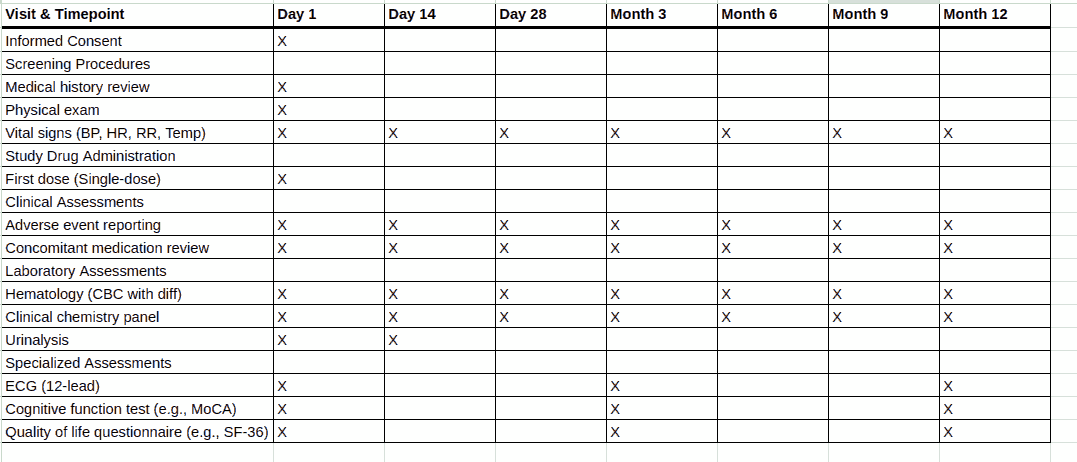
Each line corresponds to an activity. The number of X’s tell you how often that activity will take place. For example, in the above example, the patients’ vital signs will be taken seven times. So the cost per patient of the vital signs will be the cost of a single vital signs check, times 7. If this assessment costs $50, the total cost per patient in that row will be $50 x 7 = $350.
The cost of each activity can be looked up in the hospital charge master (a list of costs for that location). Some countries, particularly in Europe, have a public list of standardised costs for activities in clinical trials.
It is very important to read the footnotes as well. The footnotes may explain exactly what lab assessments will take place, and there may be more activities and costs hidden in the footnotes that weren’t immediately obvious in the schedule of events.
You may find instructions on handling the drug product in the lab manual and other documents, so ideally you will have been given a bundle of documents and you should read them to find any further activities that may not be in the protocol. For example, the informed consent form contains information on subject compensation, e.g. are subjects reimbursed $50 per visit.
Create a site budget
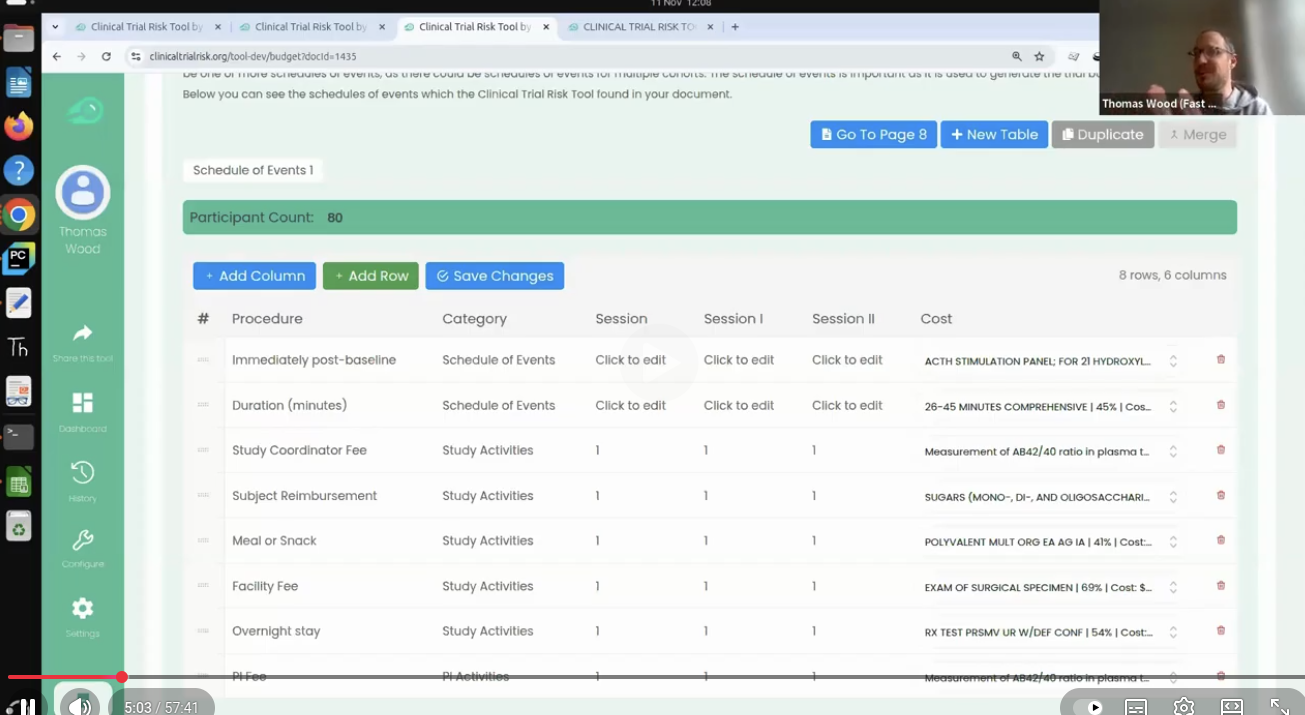
You may find it time consuming and error prone to create a site budget by copying line items one by one from the protocol into a spreadsheet. Luckily, AI can make this process less painful. Using an AI tool like the Clinical Trial Risk Tool, you can simply drag and drop the protocol PDF and the budget Excel can be created, shared, and exported. Check the demo below and you can read more in our white paper.
Sign up at https://clinicaltrialrisk.org/ to try the Clinical Trial Risk Tool.
Contact us if there are any features which you would like us to add to the tool
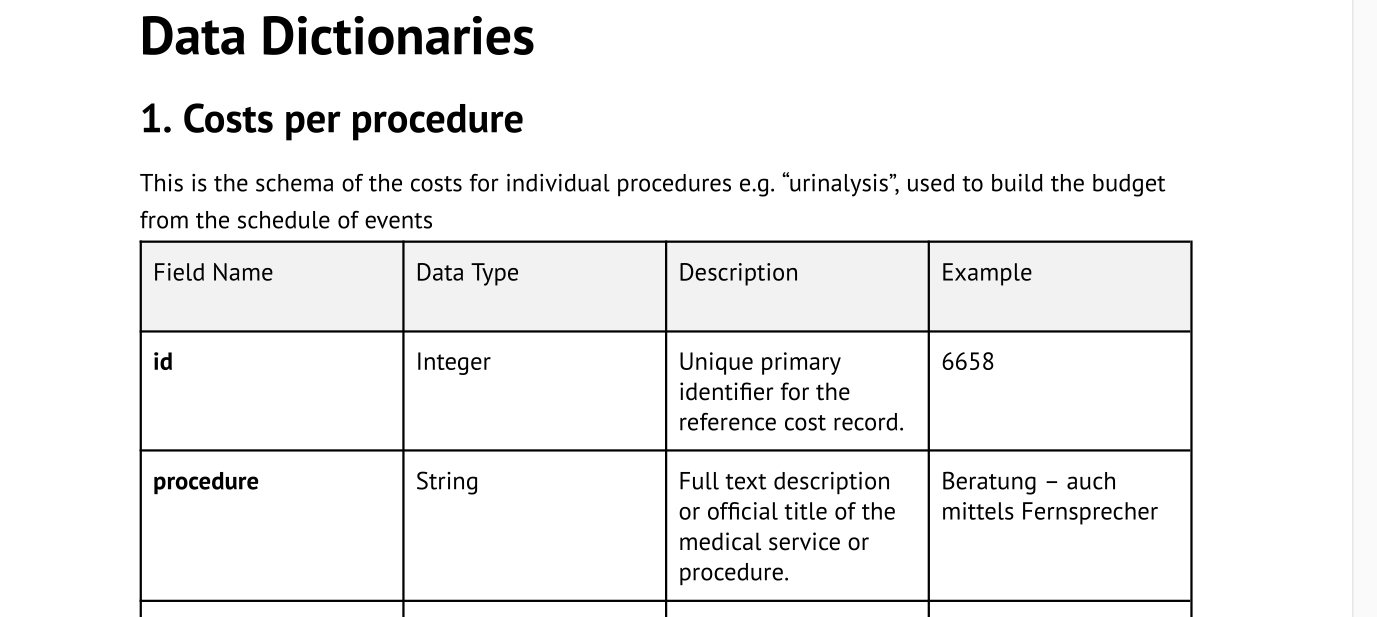
The Clinical Trial Risk Tool estimates top down cost and itemised site budgets using proprietary cost datasets of trial costs and procedure costs. These costs are assembled from publically available data. You can click below to view our data dictionary. Clinical Trial Risk Tool Trial cost data You can download the data dictionary used for cost estimation in the Clinical Trial Risk Tool Download data dictionary
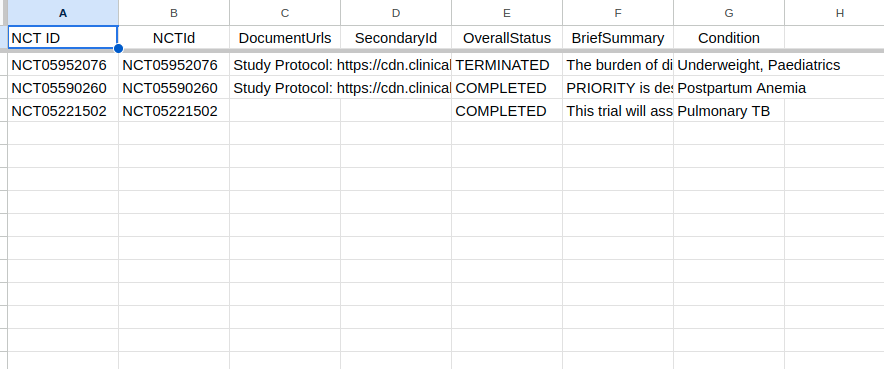
Clinical Trial Data Lookup Google Sheets™ plugin Do you need to look up clinical trial data from the NCT ID? Fast Data Science has developed a Google Sheets™ add-on (plugin) which finds clinical trials data. The plugin uses the clinicaltrials.gov API. Clinical Trial Data Google Sheets™ Plugin Install plugin Install the free Google Sheets™ plugin for looking up clinical trial data Install Plugin The user will provide a number of NCT IDs in column A (or whichever one they choose) in the Google Sheet™, and the tool will look up those NCT IDs and retrieve information on those trials and populate that information into columns.
Fast Data Science are pleased to announce that the Clinical Trial Risk Tool, has been accepted as a supplier on the UK Government’s G-Cloud 15 framework. Click here to view the Clinical Trial Risk Tool on G-Cloud 15. The G-Cloud 15 framework allows public sector bodies to buy cloud-based computing services such as AI, hosting, software and support directly without lengthy, costly traditional tender processes. Clinical Trial Risk Tool on Digital Marketplace