Clinical study budget templates and generators - best practices to follow

Clinical study budget templates and generators - best practices to follow

Guest post by Safeer Khan, Lecturer at Department of Pharmaceutical Sciences, Government College University, Lahore, Pakistan

Introduction

The success of clinical studies relies heavily on proper financial planning and budgeting. These processes directly impact key factors such as project timelines, resource allocation, and compliance with regulatory requirements. The accurate forecasting of costs for clinical trials, however, is a highly complex and resource-intensive process. A study by the Tufts Center for the Study of Drug Development found that the average cost of developing a new drug is approximately $2.6 billion. This underscores the critical need for accurate budgeting to avoid unforeseen expenditures that can cause significant financial strain.

The nature of clinical research is diverse and often unpredictable, involving multiple phases, study designs, and geographical regions. This complexity presents significant challenges in ensuring that projected expenses align with actual expenditures. In response to these challenges, recent advancements in budgeting methodologies have introduced sophisticated tools, such as clinical trial budget templates and automated budget generators. These tools provide a more streamlined and efficient approach to budgeting, reducing the time and effort traditionally required for cost estimation. Moreover, they mitigate common financial risks, including cost overruns and inefficient resource allocation, which are frequent sources of trial disruption. This blog will examine best practices for effectively utilizing clinical trial budget templates and generators.
Key Features of Clinical Study Budget Generators

Create your trial budget

Upload your protocol

Upload your clinical trial protocol in PDF form to the Clinical Trial Risk Tool and create a site budget from the protocol and charge masters.

Understanding Clinical Study Budgets

A clinical study budget outlines all projected costs, from recruitment to data analysis, ensuring that each element of the trial has sufficient financial backing [1]. Typical categories include:

  1. Personnel Costs: It encompasses all forms of compensation provided to staff directly involved in conducting the clinical trial.
  2. Site and Facility Costs: It includes the expenses required to operate clinical trial locations and support patient recruitment and enrollment activities.
  3. Study Supply Costs: It covers the materials and equipment needed to support patient care and collect clinical data throughout the trial.
  4. Regulatory and Compliance Costs: It ensures that the study meets all applicable local and international regulatory requirements.
  5. Data Management and Analysis Costs: It supports the processes necessary to maintain data quality, accuracy, and overall scientific integrity.
  6. Miscellaneous Costs: It accounts for additional, unpredictable expenses that may arise during the course of the study

Understanding the various cost categories and the complexities involved is essential for ensuring the financial viability of a clinical study. Budgeting challenges often emerge due to the unpredictable nature of clinical trials, such as delays in recruitment, unexpected regulatory issues, or unforeseen patient dropout. Therefore, a well-structured budget can help mitigate these risks, but achieving financial accuracy requires thorough planning, regular updates, and the appropriate tools [2].

Why Clinical Trial Budget Templates Are Essential

Clinical Trial Budget Templates are standardized, pre-built documents that allow researchers to track and calculate trial expenses in an organized manner. These templates are often used in early-stage budgeting to outline major expenses, such as personnel, equipment, and operational costs. Key advantages of using budget templates include:

  1. Standardization: Templates ensure a uniform approach to budgeting, helping clinical trial teams follow a consistent framework for cost estimation. This is particularly valuable for large research networks where multiple studies need to be compared.
  2. Efficiency: With set structures, clinical trial budget templates save considerable time in planning, reducing errors that can arise from manually creating a budget from scratch.
  3. Collaboration: Templates facilitate smoother collaboration among stakeholders, including clinical research coordinators, sponsors, and financial officers. They provide a clear, shared framework for financial discussions.

How Clinical Study Budget Generators Work

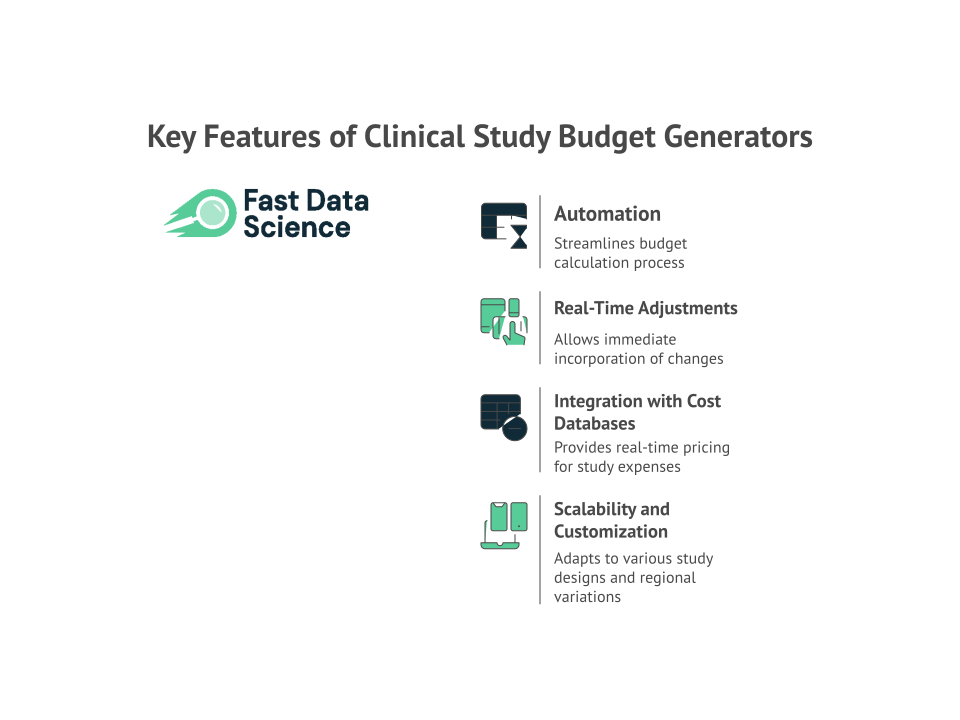
Clinical trial budget generators extend the capabilities of traditional budgeting approaches by automating substantial portions of the process. These systems enable clinical trial managers to develop budgets that are comprehensive yet adaptable, providing real-time cost estimates informed by factors such as study size, duration, and geographic setting. Key features of budget generators are:

  1. Automation: Clinical trial budget generators streamline the process by automatically calculating costs based on user-defined parameters. This reduces the potential for human error and accelerates budget development.
  2. Real-Time Adjustments: Modifications to the study protocol, site location, or timeline can be incorporated immediately. This allows the system to recalculate costs and provide an up-to-date view of the budget.
  3. Integration with Cost Databases: Many clinical trials budget generators are connected to current cost databases, enabling them to retrieve real-time pricing for study materials, site operations, and personnel-related expenses.
  4. Scalability and Customization: These tools are adaptable to a wide range of study designs, from small investigator-led trials to large multinational studies. They also support customization to reflect regional cost variations and phase-specific requirements.

AI Integration for Enhanced Risk Prediction

AI-enabled clinical trial budget generators, such as those offered by ClinicalTrialRisk.org, provide capabilities beyond basic budget creation. They can also forecast potential risks, including unexpected cost variations or delays in study timelines. By analyzing underlying data patterns, these tools produce more precise projections, thereby reducing the likelihood of unforeseen financial issues.

Best Practices for Using Templates and Generators

To maximize the utility of clinical trial budget templates and generators, it is imperative to apply established Best Practices in Clinical Research Budgeting that enhance accuracy and operational efficiency.

  1. Select an Appropriate Template or Generator: It is essential to choose budgeting tools that align with the specific requirements of the study. Templates and generators should meet industry standards and offer sufficient flexibility to accommodate study-specific features. Factors such as study phase, scale, and geographical scope should guide the selection process.
  2. Engage Stakeholders from the Outset: Early involvement of key contributors, including project managers, principal investigators, and finance teams, is critical. Their combined input ensures that the budget captures all relevant cost elements and reduces the likelihood of overlooking essential components.
  3. Adapt Tools to Study-Specific Characteristics: Even when starting with a general template, customization is necessary to reflect the unique attributes of the study. This may include incorporating patient recruitment expenses, regulatory requirements, or logistical considerations related to specific disease areas or regional contexts.
  4. Conduct Ongoing Budget Review and Revision: Because budgeting is an iterative process, clinical trial budgets must be updated regularly to accommodate changes in study scope or unforeseen expenditures. Tools that support real-time updates are particularly valuable for maintaining accurate financial oversight.
  5. Utilize Historical Data to Enhance Accuracy: Drawing on data from previous studies or comparable protocols improves the precision of cost estimates. Historical financial information provides realistic reference points for typical expenditures across study activities.
  6. Account for Regulatory and Risk-Related Factors: Budgets should incorporate all regulatory obligations, including fees associated with agencies such as the FDA, as well as risk-related elements such as recruitment difficulties or increased monitoring needs. Risk-forecasting tools, such as those available through ClinicalTrialRisk.org, can support early identification of these factors.
  7. Ensure Comprehensive Cost Tracking and Reporting: Effective budgeting requires tools that facilitate detailed monitoring of expenditures relative to projections. Such systems promote transparency, support timely decision-making, and enable corrective action when deviations arise.

Common Mistakes to Avoid

  1. Overlooking Indirect Expenses: Administrative costs, institutional overhead, travel, and insurance fees are frequently underestimated, yet they can represent a substantial portion of the total budget.
  2. Underestimating Recruitment Expenditures: Participant recruitment often proves more costly than expected, particularly in studies involving narrowly defined populations or rare diseases.
  3. Disregarding Regional Cost Differences: Costs can vary widely between regions, making geographic differences an important consideration in budgeting. International trials, in particular, must factor in currency exchange shifts, travel needs, and variations in local regulatory requirements [3].

Conclusion

The clinical trial budget templates and automated budget generators not only streamlines the budgeting process but also enhances financial accuracy and strengthens risk management. As clinical trials become increasingly complex, the integration of advanced tools, including those with AI-based risk prediction capabilities, helps ensure that budgets remain both robust and adaptable. However, the effectiveness of these tools is maximized when they are used in conjunction with established best practices, enabling researchers to more effectively navigate the financial complexities of clinical research while maintaining focus on their scientific objectives.

References

  1. Nevens, H., et al., Budgeting of non-commercial clinical trials: development of a budget tool by a public funding agency. Trials, 2019. 20(1): p. 714.

  2. Fassas, E. and S. Wang, Budgeting for clinical trials, in Translational Urology. 2025, Elsevier. p. 283-286.

  3. Gumber, L., et al., Operational complexities in international clinical trials: a systematic review of challenges and proposed solutions. BMJ open, 2024. 14(4): p. e077132.
The anatomy of an oncology clinical trial protocol

The anatomy of an oncology clinical trial protocol

Guest post by Safeer Khan, Lecturer at Department of Pharmaceutical Sciences, Government College University, Lahore, Pakistan Introduction Recent years have seen a substantial rise in oncology clinical trials, with annual growth exceeding 260 studies on average [1]. Despite this increase, these studies continue to be some of the most demanding and resource-intensive in clinical research. The combination of intensive monitoring, detailed assessment schedules, and highly specific eligibility criteria creates substantial operational challenges.

Six ways to deal with rising clinical trial costs

Six ways to deal with rising clinical trial costs

Guest post by Safeer Khan, Lecturer at Department of Pharmaceutical Sciences, Government College University, Lahore, Pakistan Introduction In recent years, the cost of conducting clinical trials has risen dramatically. This increase has posed a significant challenge for pharmaceutical companies, researchers, and healthcare innovators. According to a study published in Nature Reviews in 2017, the median cost of conducting a study was $3.4 million for phase I trials, $8.6 million for phase II trials, and $21.

Clinical trial funding - top challenges and best practices

Clinical trial funding - top challenges and best practices

Guest post by Youssef Soliman, medical student at Assiut University and biostatistician Clinical trials are the mainstay of medical innovation, but they are also notoriously expensive and resource-intensive. Funding for clinical trials comes from a wide variety of sources, yet the vast majority of funding typically comes from pharmaceutical sponsors who have the greatest stake in a trial’s success [1]. This reliance on industry funding, coupled with the immense costs of conducting trials, makes securing and managing financial support one of the top challenges in clinical research.