We have improved the Clinical Trial Risk Tool in the last 6 months, making it more user friendly and taking on board the feedback that we’ve received. We’ve improved the accuracy of the machine learning components too.
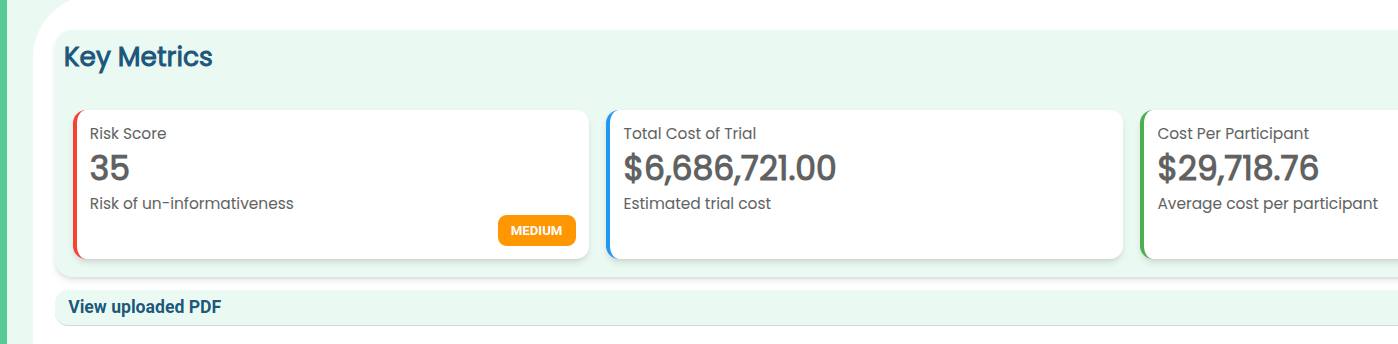
The tool now outputs its key figures such as risk levels and estimated cost in easily readable cards, so you can see at a glance the key takeaways from your protocol:
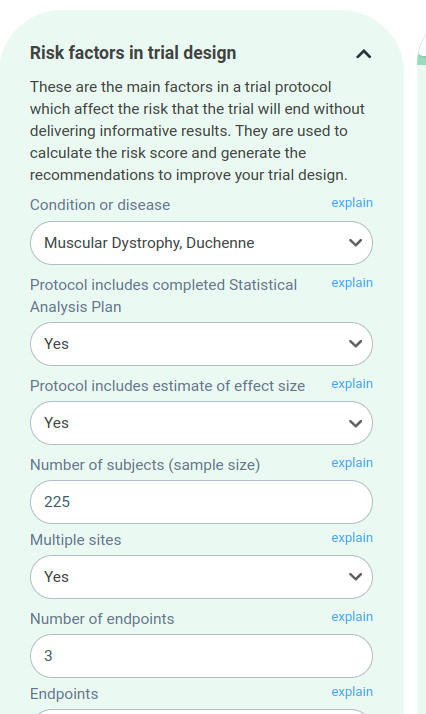
The risk factors are now organised into collapsible categories, so you can explore them easily without an information overload.
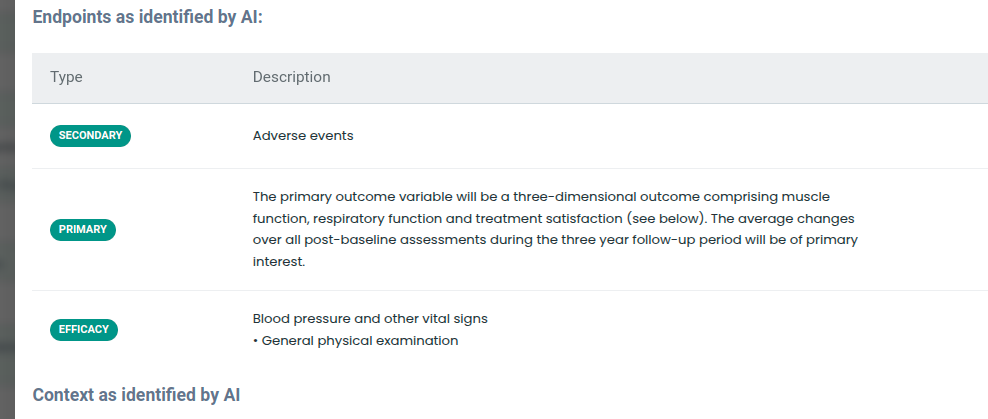
The tool identifies endpoints and inclusion and exclusion criteria. In future, we are hoping to use this to retrieve trials with comparable endpoints or criteria from the registries such as ClinicalTrials.gov.
Check your trial design
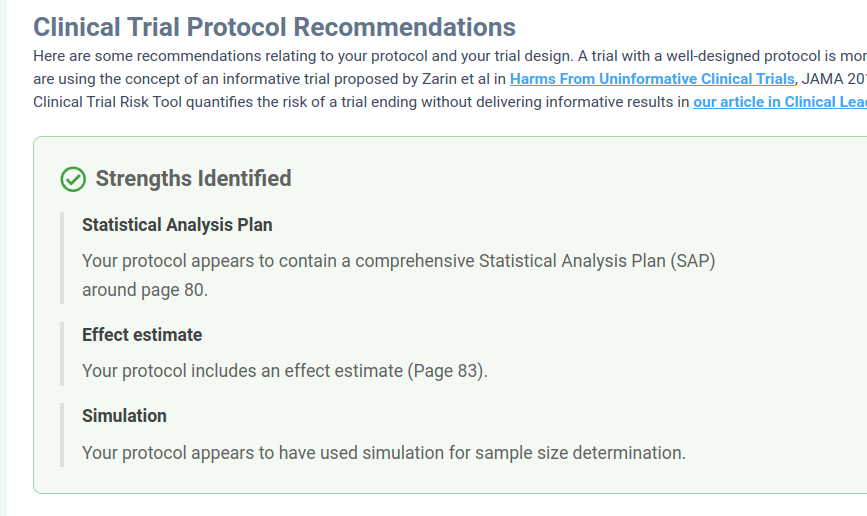
We have an easily digestible set of recommendations for the user to improve the trial, so you can see what are the high priority actions that you need to take with your protocol.
Currently we’re working on a feature to allow the user to generate an itemised budget for the trial in Excel from the schedule of events. We expect this to take a few months and to be finished in Q4 of 2025.
We are also working on making the tool output the probability of success for the trial. A number of groups have calculated aggregate statistics around trials proceeding from Phase 1->Phase 2, or Phase 3->approval, etc, e.g. MIT’s Project Alpha or Chufan Gao, Automatically Labeling Clinical Trial Outcomes, so these statistics or machine learning models could be integrated into the tool, and in addition to outputting the “risk score” it could also output the “probability of success” or similar, based on past trials.
We hope to also produce an accountable budget range (where should a reasonable bid fall), based on past trials.
Gao, Chufan, et al. Automatically Labeling Clinical Trial Outcomes: A Large-Scale Benchmark for Drug Development. arXiv preprint arXiv:2406.10292 (2024).
Shomesh Chaudhuri, Joonhyuk Cho, Andrew W. Lo, Manish Singh, and Chi Heem Wong, Debiasing Probability of Success Estimates for Clinical Trials (2022)
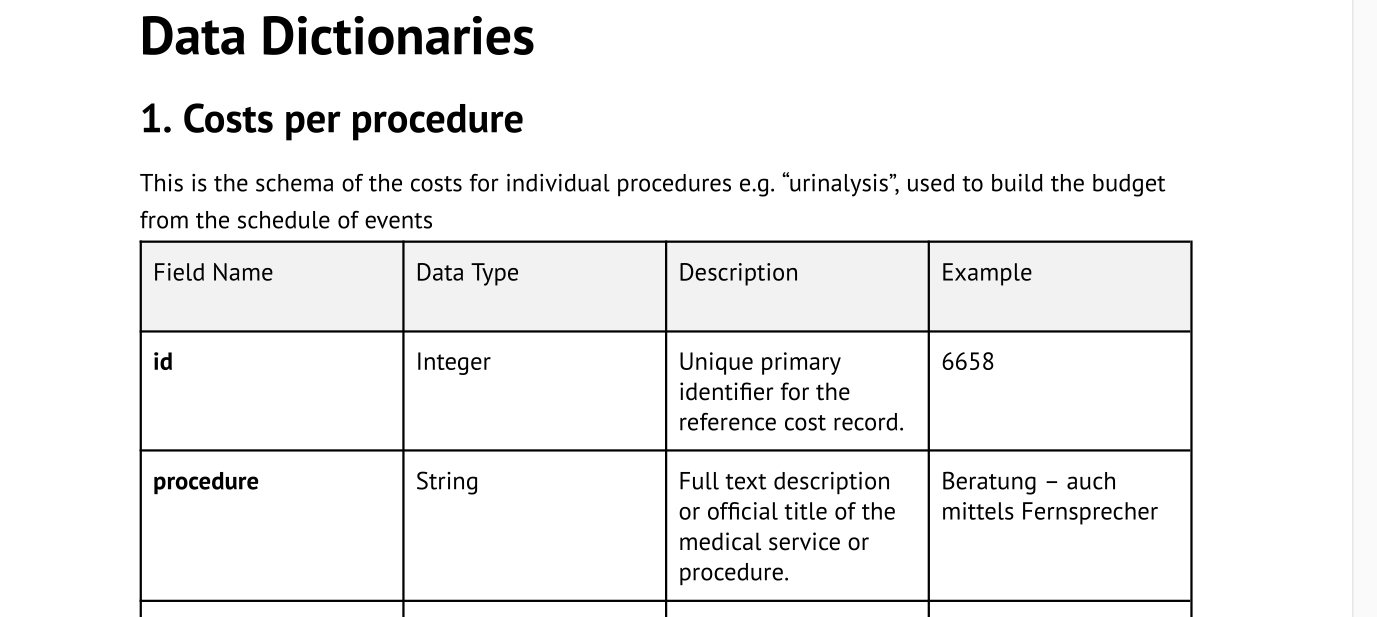
The Clinical Trial Risk Tool estimates top down cost and itemised site budgets using proprietary cost datasets of trial costs and procedure costs. These costs are assembled from publically available data. You can click below to view our data dictionary. Clinical Trial Risk Tool Trial cost data You can download the data dictionary used for cost estimation in the Clinical Trial Risk Tool Download data dictionary
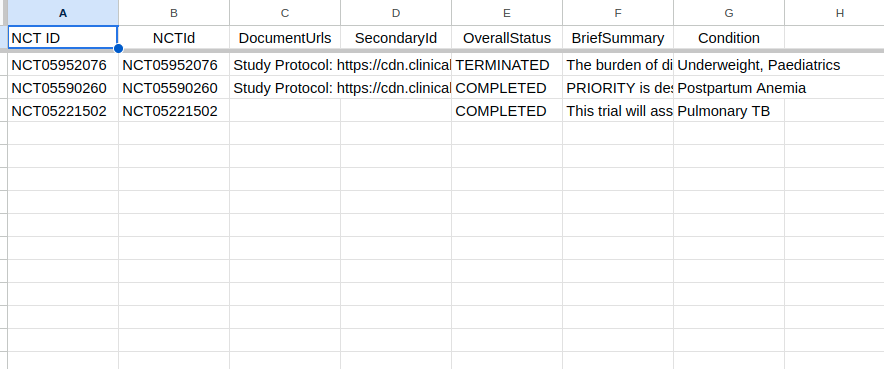
Clinical Trial Data Lookup Google Sheets™ plugin Do you need to look up clinical trial data from the NCT ID? Fast Data Science has developed a Google Sheets™ add-on (plugin) which finds clinical trials data. The plugin uses the clinicaltrials.gov API. Clinical Trial Data Google Sheets™ Plugin Install plugin Install the free Google Sheets™ plugin for looking up clinical trial data Install Plugin The user will provide a number of NCT IDs in column A (or whichever one they choose) in the Google Sheet™, and the tool will look up those NCT IDs and retrieve information on those trials and populate that information into columns.

You may have been tasked with creating a clinical trial site budget. This is a budget itemising all the costs that will be incurred at the study site. The site budget may be needed To estimate the total cost of that site running part of the trial, as part of a bid to the CRO or sponsor To identify who needs to be reimbursed for each cost item To ascertain whether or not it is feasible to run the trial at that site To ensure that the site is reimbursed for the costs that they incur while running the trial If you are building a site budget, the most important document is the study protocol.