Guest post by Safeer Khan, Lecturer at Department of Pharmaceutical Sciences, Government College University, Lahore, Pakistan
Recent years have seen a substantial rise in oncology clinical trials, with annual growth exceeding 260 studies on average [1]. Despite this increase, these studies continue to be some of the most demanding and resource-intensive in clinical research.
The combination of intensive monitoring, detailed assessment schedules, and highly specific eligibility criteria creates substantial operational challenges. As a result, recognizing potential risks early in the planning phase has become essential. Tools such as the Predictive Clinical Trial Risk Tool, can support stakeholders in identifying areas of a draft protocol that may be difficult to execute.
Check your oncology study design
There is no antineoplastic agent that can be considered completely free of toxicities [2]. For these reasons, oncology protocols typically include intensive safety monitoring, regular laboratory testing, and detailed dose modification guidelines. While these steps are essential for patient protection, each additional assessment adds operational costs and creates more opportunities for protocol deviations.
Clinical trials have evolved from traditional studies of cytotoxic chemotherapy to more adaptive, biomarker-guided designs [3]. These designs make extensive use of biomarkers, genomic testing, and centralized imaging to improve patient selection and assess treatment response. However, when these demands exceed a site’s technical capacity or place too much burden on patients, they can lead to operational delays and reduced trial efficiency.
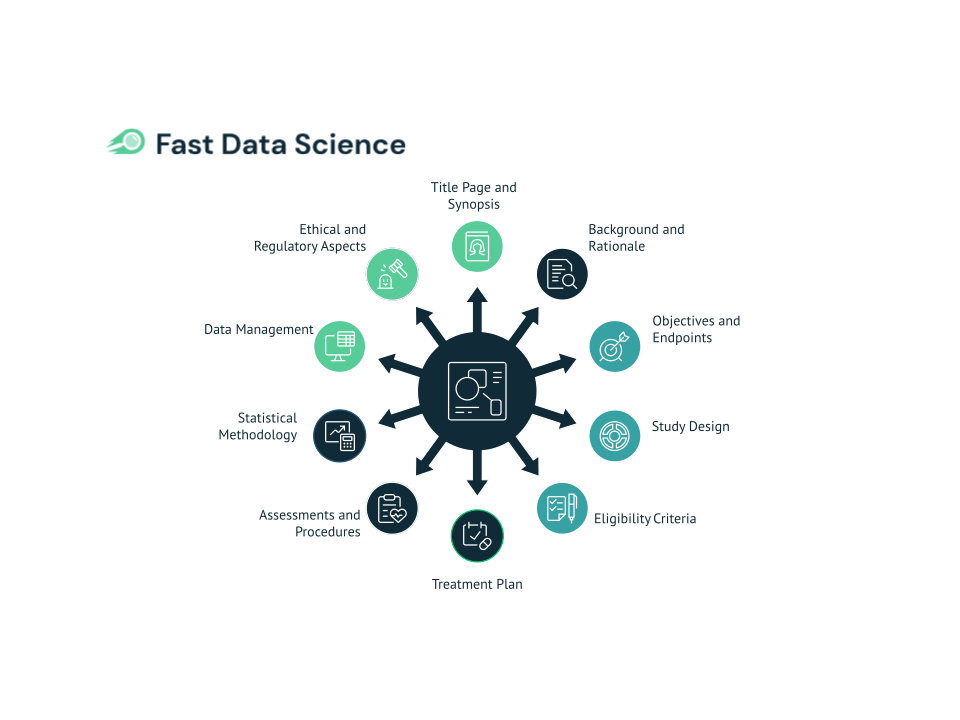
The fundamental elements of oncology protocol align with those of other clinical studies. Read more about: Protocol Design for Clinical Trials. However, the complexity of cancer research necessitates a more focused and rigorous approach when developing these components.
In oncology clinical trial protocol, the study synopsis gives the first clear picture of the trial’s structure. It summarizes the objectives, cancer population, biomarker requirements, treatment regimen, and key endpoints. Sites depend on this overview to judge whether they have the patients and capability to participate, which is critical given that about 40% of trials sponsored by the National Cancer Institute never reach completion. Sponsors also use the synopsis to estimate early timelines and budget needs.
In oncology clinical trial protocol, this section often includes key assumptions about biomarker prevalence, patterns of tumor behavior, and anticipated effect sizes. If these assumptions are inaccurate, the downstream elements of the protocol may not perform as intended. Ensuring that the rationale is grounded in reliable evidence is essential for building a protocol that is both scientifically sound and operationally feasible.
Oncology clinical trial protocol often include a broad set of endpoints. Common measures include progression-free survival, overall survival, objective response rate, duration of response, and various safety outcomes [4]. Although each endpoint may contribute valuable insight, every additional measure expands the amount of data that must be collected and managed throughout the study. For instance, endpoints that rely heavily on imaging create added operational pressure [5]. Therefore, defining a focused and well-justified set of endpoints is essential for maintaining both scientific clarity and operational efficiency.
Oncology clinical trial protocol may use a variety of designs, ranging from conventional randomized controlled trials to more specialized approaches such as dose-escalation studies, basket trials, umbrella trials, and adaptive designs [6]. While each approach offers scientific advantages, it also brings additional layers of operational complexity. These design choices have a direct impact on workload, logistics, and overall trial cost. Selecting a design that answers the research question while remaining practical for participating sites is critical to ensuring efficient and cost-effective trial conduct.
In oncology clinical trial protocol, eligibility criteria include detailed requirements related to biomarkers, genetic mutations, prior treatments, organ function, and overall performance status. As these requirements become more specific, the number of patients who qualify naturally decreases. This narrowing is a major reason many oncology trials struggle to recruit on time, leading to delays, higher costs, and added pressure on study sites [7].
Oncology clinical trial protocols often include complex dosing schedules, dose-escalation phases, combination regimens, and detailed toxicity management rules. Each requirement in this section influences site operations, from drug preparation and infusion time to dose adjustments and additional safety assessments. Therefore, designing a dosing strategy that is both scientifically sound and practical for sites is essential for maintaining trial efficiency
Oncology trials require frequent and detailed assessments to track patient safety and measure treatment response. These can include imaging, laboratory evaluations, biomarker and genomic testing, ECGs, vital signs, and quality-of-life instruments. Because many of these procedures are resource-intensive, they often become key sources of delay. Developing an assessment schedule that balances scientific value with operational practicality is essential to reducing burden and keeping the study on schedule.
This section typically includes sample size calculation, assumptions about survival or event rates, power analyses, and plans for interim evaluations. These assumptions guide both the design and duration of the trial. Careful planning in this section is essential, as the statistical framework directly influences feasibility, resource needs, and the overall likelihood of generating interpretable results.
Oncology trials generate large, complex datasets due to frequent imaging, extensive safety reporting, laboratory testing, and prolonged follow-up. Monitoring these data is a major driver of both cost and operational effort. When monitoring expectations are too intensive, expenses rise quickly because of increased site visits and data review. However, if monitoring is too limited, data quality may suffer, leading to delays from unresolved queries or missing information.
Oncology trials receive a high level of regulatory scrutiny due to the potential risks associated with treatment. Read more about: Clinical Trial Regulations in 2025. The protocol must clearly outline the informed consent process, plans for Data and Safety Monitoring Board (DSMB) oversight, required reporting timelines, and procedures for managing adverse events.
Moreover, regulatory agencies frequently request clarifications or revisions to oncology protocols. Therefore, preparing thorough and well-justified sections in advance helps reduce the need for multiple rounds of revisions and supports a smoother approval process.
According to Guideline for Good Clinical Practice, a clinical trial protocol must be supported by a set of essential documents that collectively ensure the study is conducted to high scientific and ethical standards
The Investigator’s Brochure provides a comprehensive overview of all existing knowledge about the investigational drug. Study sites use this document to understand the drug’s potential risks and to anticipate possible toxicities, making it an essential resource for ensuring safe and consistent trial conduct.
The Informed Consent Form is the main document used to explain the study to potential participants. As it guides the patient’s decision to participate, the consent must align precisely with the protocol and present information in a clear and accurate manner.
Institutional Review Boards are responsible for safeguarding patient welfare and ensuring that ethical standards are upheld throughout the study. Their approval is required before the trial can begin and must be maintained as the study progresses.
After the protocol is approved, study sites require detailed guidance on how to carry it out in practice. The manual of operations serves this purpose by translating protocol requirements into step-by-step instructions for daily activities. This document helps ensure that all sites follow the protocol consistently and accurately.
[Case Report Forms](https://novotech-cro.com/faq/what-case-report-form#:~:text=A%20Case%20Report%20Form%20(CRF,set%20out%20by%20regulatory%20agencies) specify the exact data that sites are required to capture during the study. They are developed directly from the protocol’s endpoints, assessments, and procedural requirements, ensuring that all necessary clinical and safety information is collected in a structured and consistent manner.
Oncology clinical trial protocols are essential for ensuring that studies are scientifically robust, operationally feasible, and safe for participants. Given the complexity of cancer treatments, the intensity of monitoring, and the specificity of patient populations, every component of the protocol carries meaningful operational consequences. Likewise, all supporting documents must be closely aligned with the protocol to preserve accuracy and meet regulatory standards.
Vuger, A.T., et al., Globalization of clinical research in oncology: status, challenges, and future directions. Journal of Cancer Policy, 2024. 42: p. 100500.
Basak, D., et al., Comparison of anticancer drug toxicities: paradigm shift in adverse effect profile. Life, 2021. 12(1): p. 48.
Spreafico, A., et al., The future of clinical trial design in oncology. Cancer discovery, 2021. 11(4): p. 822-837.
Delgado, A. and A.K. Guddati, Clinical endpoints in oncology-a primer. American journal of cancer research, 2021. 11(4): p. 1121.
Gillam, L.D., J. Leipsic, and N.J. Weissman, Use of Imaging Endpoints in Clinical Trials. JACC Cardiovasc Imaging, 2017. 10(3): p. 296-303.
Tsimberidou, A.M., P. Müller, and Y. Ji. Innovative trial design in precision oncology. in Seminars in cancer biology. 2022. Elsevier.
Jacques, R.M., et al., Recruitment, consent and retention of participants in randomised controlled trials: a review of trials published in the National Institute for Health Research (NIHR) Journals Library (1997-2020). BMJ open, 2022. 12(2): p. e059230.
Estimating the total cost of a clinical trial before it runs is challenging. Public data on past trial costs can be hard to come by, as many companies guard this information carefully. Trials in high income countries and low and middle income countries have very different costs. Upload your clinical trial protocol and create a cost benchmark with AI Protocol to cost benchmark The Clinical Trial Risk Tool uses AI and Natural Language Processing (NLP) to estimate the cost of a trial using the information contained in the clinical trial protocol.
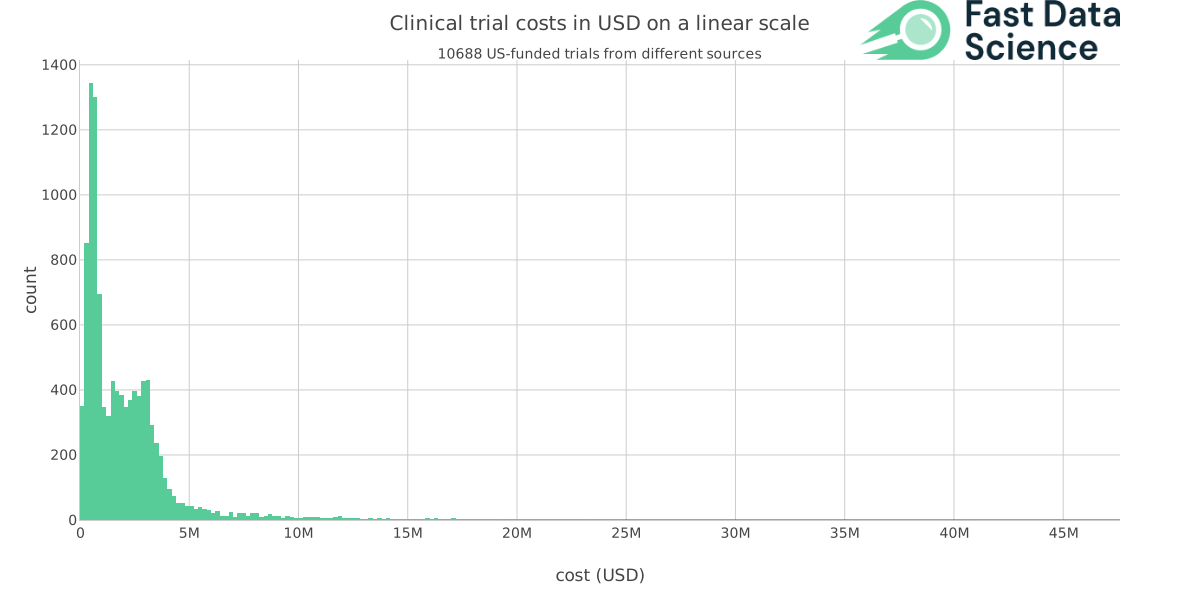
You can download a white paper about clinical trial cost benchmarking here Estimating the total cost of a clinical trial before it runs is challenging. Public data on past trial costs can be hard to come by, as many companies guard this information carefully. Trials in high income countries and low and middle income countries have very different costs. Clinical trial costs are not normally distributed.[1] I took a dataset of just over 10,000 US-funded trials.

Guest post by Safeer Khan, Lecturer at Department of Pharmaceutical Sciences, Government College University, Lahore, Pakistan Introduction The success of clinical studies relies heavily on proper financial planning and budgeting. These processes directly impact key factors such as project timelines, resource allocation, and compliance with regulatory requirements. The accurate forecasting of costs for clinical trials, however, is a highly complex and resource-intensive process. A study by the Tufts Center for the Study of Drug Development found that the average cost of developing a new drug is approximately $2.