You can use the Chi-Squared test to analyse your trial data or A/B test data if you have two groups with a dichotomous outcome. For example, you have two arms in your trial: the placebo and the intervention arm, and your endpoint is either yes or no, such as “did the subject experience an adverse event during the trial”.
The calculator below will calculate the minimum sample size for you. Your expected effect size w is the standardised effect size according to Cohen’s definition. You can estimate your expected effect size from the literature. An effect size is considered small if w = 0.10, medium if w = 0.30 and large if w = 0.50.[1]
You may also be interested in our Bayesian A/B test calculator.
Estimating the total cost of a clinical trial before it runs is challenging. Public data on past trial costs can be hard to come by, as many companies guard this information carefully. Trials in high income countries and low and middle income countries have very different costs. Upload your clinical trial protocol and create a cost benchmark with AI Protocol to cost benchmark The Clinical Trial Risk Tool uses AI and Natural Language Processing (NLP) to estimate the cost of a trial using the information contained in the clinical trial protocol.
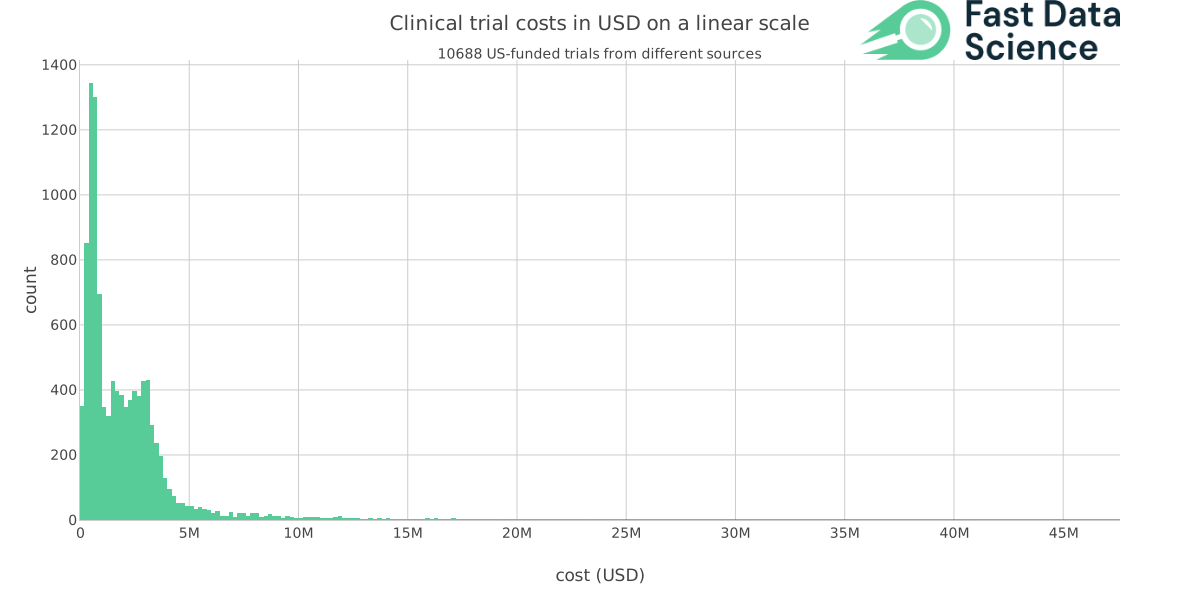
You can download a white paper about clinical trial cost benchmarking here Estimating the total cost of a clinical trial before it runs is challenging. Public data on past trial costs can be hard to come by, as many companies guard this information carefully. Trials in high income countries and low and middle income countries have very different costs. Clinical trial costs are not normally distributed.[1] I took a dataset of just over 10,000 US-funded trials.

Guest post by Safeer Khan, Lecturer at Department of Pharmaceutical Sciences, Government College University, Lahore, Pakistan Introduction The success of clinical studies relies heavily on proper financial planning and budgeting. These processes directly impact key factors such as project timelines, resource allocation, and compliance with regulatory requirements. The accurate forecasting of costs for clinical trials, however, is a highly complex and resource-intensive process. A study by the Tufts Center for the Study of Drug Development found that the average cost of developing a new drug is approximately $2.